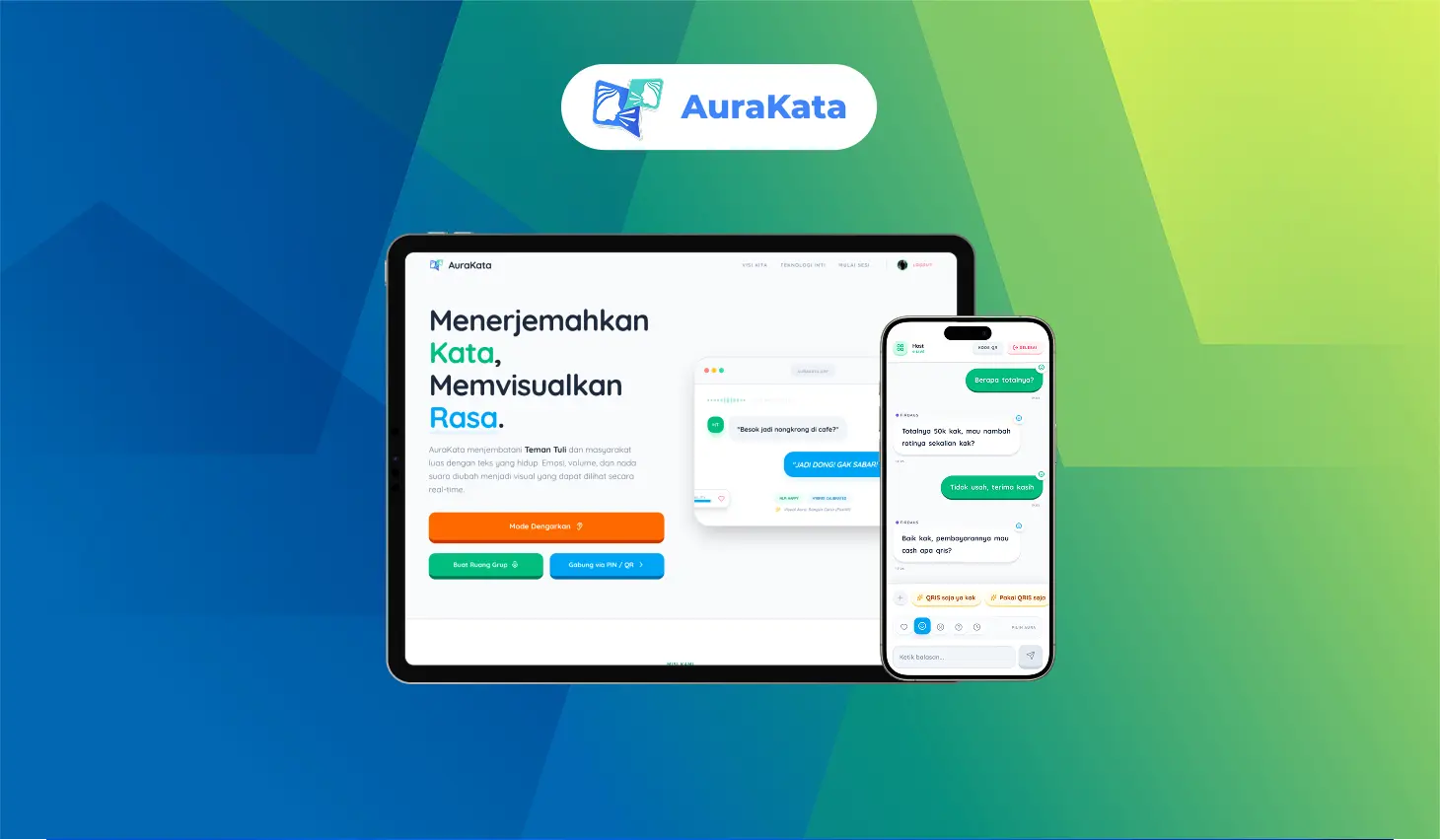
AuraKata
AuraKata is an accessibility-focused web platform designed to help deaf and hard-of-hearing users better understand spoken conversations through real-time transcription and expressive visual typography. Instead of only displaying words, AuraKata visualizes emotional cues such as intensity, tone, and speaking energy, helping users capture the meaning behind a conversation more clearly.
Project Type
Individual Project
Project For
Google Juara Vibe Coding Competition
Role
Sole Full-Stack AI Engineer
Platform
Web-based
Year
2026
Technology Stack
The Challenges & Solutions
Handling Audio Variability
During testing, I found that different environments produced very different microphone responses. Quiet rooms, noisy spaces, and sudden loud sounds could make the visual output feel **inconsistent or distracting**. To make the experience more reliable, I built an adaptive audio normalization system that calibrates input levels in real time, allowing the typography to respond more naturally to meaningful speech.
Mitigating NLP Bias
I discovered that text-based emotion models could misinterpret **casual Indonesian slang** as negative or angry, especially when the model relied only on written language. To reduce this bias, I designed a hybrid emotion logic that compares language predictions with acoustic cues such as relative loudness. When the spoken intensity does not match an angry prediction, the system adjusts the output to create a more balanced and context-aware interpretation.
The Impact I Made
As the sole developer, I built AuraKata **end-to-end**, from the Next.js frontend and real-time interaction flow to the AI-assisted interpretation logic. I built a fully functional web-based prototype that allows users to access the platform instantly through a QR code, reducing onboarding time to **under 5 seconds** without requiring installation. I also improved the emotional interpretation flow by combining text-based NLP with acoustic cues, reaching **95% accuracy in internal prototype testing** under controlled speech scenarios.
What I Learned
Developing AuraKata changed the way I think about **accessibility**. I learned that inclusive technology is not only about adding features, but about understanding the small details that affect real communication. **Words alone are often not enough.** Tone, intensity, and context also shape how people understand each other. This project taught me to design technology that listens not only to data, but also to human experience.