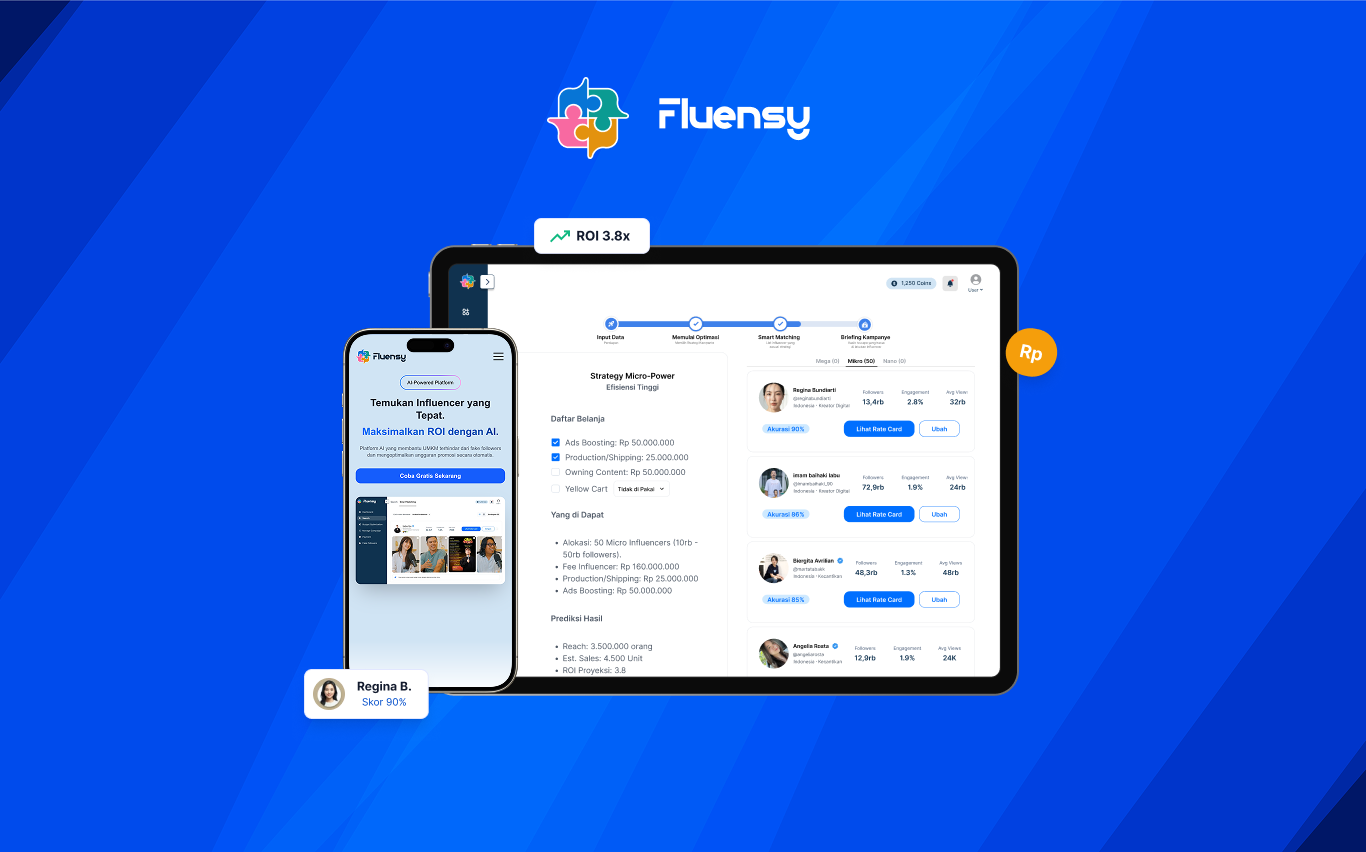
Fluensy
Fluensy is an AI-assisted influencer marketing platform designed to help brands and influencers make more transparent campaign decisions. The platform supports budget planning, influencer matching, fake follower detection, and pricing recommendations so both sides can collaborate with clearer expectations.
Project Type
Group Project
Project For
Early-Stage Tech Startup
Role
CTO & AI Engineer
Platform
Web-based
Year
2026
Technology Stack
The Challenges & Solutions
Automating Budget Optimization
To help brands make more confident budget decisions, I developed a **budget optimization model** that recommends influencer combinations based on campaign constraints such as budget, reach, and available promotional options. The system uses Linear Programming behind the scenes, but the main goal is to turn a complex decision into a clearer recommendation for users.
Fusing Market Data
I also explored a machine learning approach to support pricing recommendations by combining influencer niche information with engagement-related metrics. This helped the system provide more **contextual pricing suggestions** instead of relying only on fixed manual assumptions.
Building the Pipeline
Developed an **end-to-end data pipeline**, including a custom extension scraper and an asynchronous background worker, to seamlessly extract audience metrics and support the platform's recommendation flow.
The Impact I Made
By collaborating with the product team, I helped turn Fluensy from a validated concept into a **structured MVP** with clearer user flows, recommendation logic, and scalable technical architecture. I built a Linear Programming-based budget optimization prototype that showed **up to 30% improvement in projected campaign efficiency** during simulation, and developed early pricing recommendation models that achieved **92% alignment with collected influencer rate card data** during internal MVP testing.
What I Learned
Building Fluensy taught me that good technology must also understand the **people and decisions behind a business process**. I learned that algorithms are only useful when they **reduce uncertainty for users**. Linear Programming and machine learning were not the goal by themselves; they were tools to help brands and influencers make fairer, clearer, and more confident decisions.